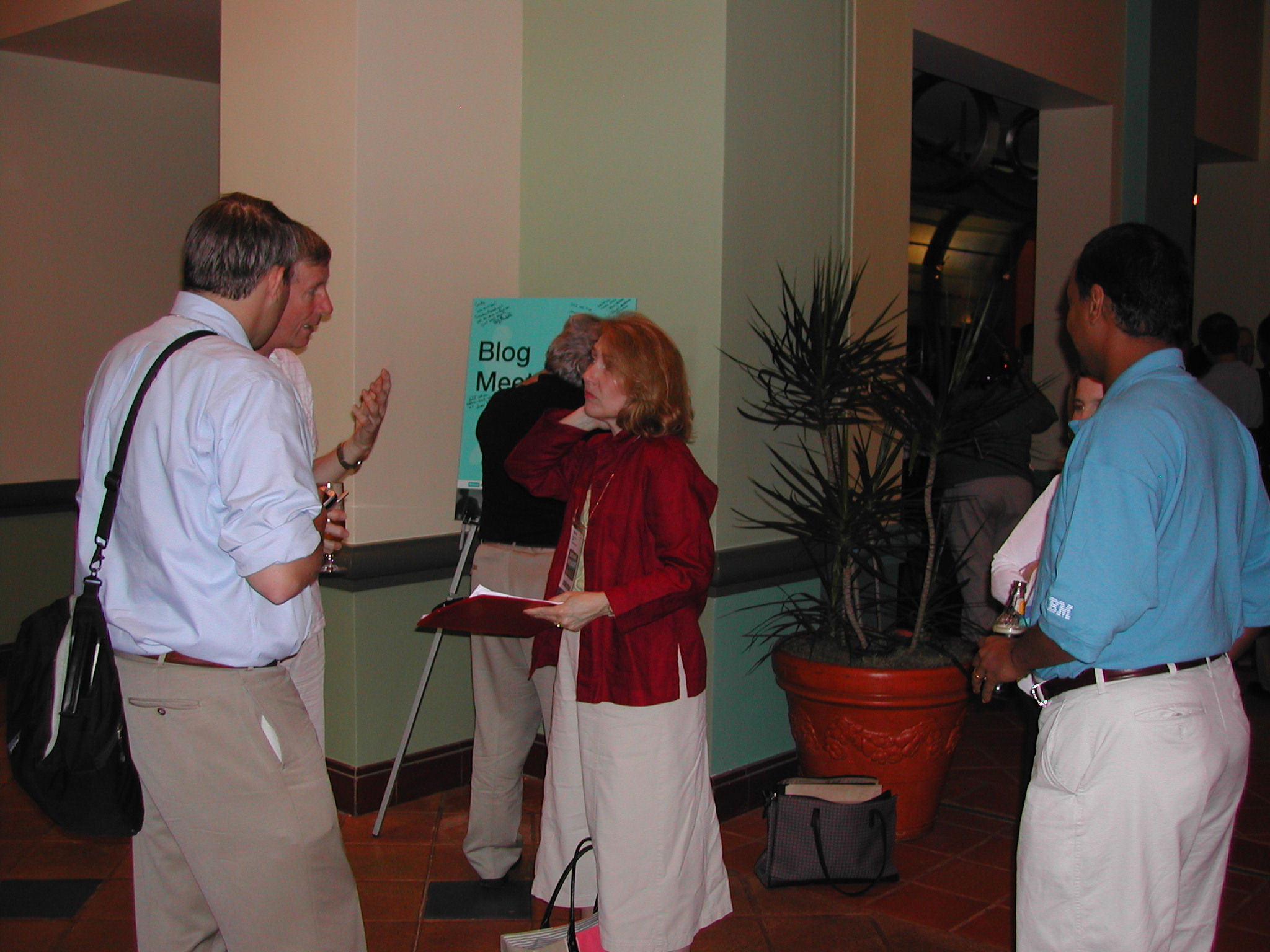
Here is a really cool video of Sam the man at the BPLC conference. One very cool feature is the annotations that Frank puts in like the warning to Salesforce.com….look out App Exchange. Thanks Frank

Click on the Link to the video of Sam.

Here is the link to the entire blog where Frank discusses IBM’s Blue Business Platform. Watch out SaaS marketplace, this one comes with Partners, a Server, Lotus support, GBS Services….and it’s SMB focused.

Why does this matter for analyst relations? We started talking to Frank more than eight months before this got posted, so you can see the cycle of behind the scenes talks that go on about what we are doing and why the analysts know IBM so well.

One of the things we tried to do to influence analyst relations is to add new tools.  Now I readily admit that video is not a new tool, but using it is another bullet in the gun, so a tool that is expanding in our A/R arsenal at events.

Special thanks to Cote of RedMonk who did all the work here.  At the bottom is his interview of me, so have at it, I can take a joke.

Jamie Thomas on RSDC

Grady Booch on Multi Core UML

Scott Hebner on Rational Team Concert, SaaS and Jazz thinking

Laura Bennett on alphaWorks and developerWorks

Telelogic

Ashok Reddy on Rational jazz

Mike Orourke on Rational Team Concert

Dave Klavon on Testing

John Simonds
, yes yours truly on Blogs, Tags, and Twitter in Analyst Relations

I sit in the audience, this time in the front row instead of the escape seats as I, like the rest of the geeks at the show are here early for William Shatner.

kirk01

Of course there’s Boston Legal and TJ Hooker and even Priceline.com, but no one will argue that it’s Captain Kirk who saved the universe more often or better. He always got the girl, even if she was green. Heck, he even had the first interracial kiss on screen, a ground breaker socially.

Of course he’s less known, except by country music fans as the Dad in (I’m so much cooler )”Online” with superstar Brad Paisley.

So Scott Hebner, my buddy, you are the host, but it looks like the audience is here for Captain James T. Kirk.

The worst software failure? Star Trek V, and he directed it, besides Paris Hilton’s hacked cell phone.

He make comparisons to software and making movies, geeks who haven’t seen the sun vs. movie writers who have been in the sun too long. The guy was humorous.

Gene Roddenberry said God stories don’t work, and he was right. It was his learning point of his Star Trek experience, when to compromise and when to make a decision.

He talked about peculiarities of actors, and some who face issues without compromise. His point was peoples opinions count, but you need to stand for your principles.

Coders = Directors

Time is the enemy when a deadline is near. He spoke of anything that can fail will when directing, murphy’s law. He was trying to relate to software writing, but mainly talked about movies….thanks Bill, I enjoyed the stories. At least he called programmers geeks, another good call.

He went through Star Trek, Grooms Lake, Tech War, the movie business and luck in the movie business.

Sci Fi films have to do with Computers and Software, a new problems. Star Trek used ILM, except for Star Trek V where the choice of software firms caused it to be a less than stellar iteration of the Star Trek series. I agree, The Wrath of Khan was the best Star Trek movie made.

You never know when someone will fart a good idea at you….how some good movies are made, that was the line of the presentation for his portion of how to make a movie.

The importance of the feeling of generosity is important to the productivity of a group. Making movies is a group effort.

Communication in groups is solved by mathematics for software development, but not in movies. In show business, anything might work.

Live to try again, that is the lesson of learning, even if you are Al Gore, losing candidate in 2000.

Biggest clap was for IBM inviting Shatner to speak at the RSDC.

It was a good speech which I listened instead of blogging well, but who cares, I was there with Captain Kirk.

By jsimonds | May 29, 2008 - 9:39 am - Posted in ibm

For those that don’t know this term, it is the highest honor that IBM can bestow on an inventor/engineer/contributor.  These are the best and brightest not just at IBM but in the industry.

On occasion, I’ve had the opportunity to speak with other fellows and I can say that this is why IBM has been and is one of the technology leaders in the industry.  Here is the line up of new fellows and press release:
IBM has elevated nine employees to the title of IBM Fellow — its most prestigious technical honor. The company also presented more than $3.5 million in cash awards to corporate and patent portfolio awardees in addition to awards given to more than 500 IBM technical leaders from around the world directly responsible for collaborating to deliver true innovation and business value every day.

Nine employees who earned the coveted distinction of IBM Fellow: Pictures here

Emmanuel Crabbé
Systems and Technology Group, East Fishkill, New York
Dr. Emmanuel Crabbé is an extraordinary and steadfast contributor to the I B M Systems a n d Technology Group. As Chief Technologist for the Systems Group, he has consistently demonstrated leadership in technology development, qualification, and product bringup. In particular, Dr. Crabbé’s work in leading the process development team that designed and implemented the 65-nanometer process resulted in the successful general availability of the eClipz POWER6 system in June 2007. His work in this area has led directly to the POWER6 systems boasting the world’s highest frequency of operation.

Robert H. High Jr.
Software Group, Austin, Texas
As an industry pioneer in the field of Services Oriented Architecture (SOA), Robert H. High Jr. has positioned IBM as a leader in delivering critical technologies to its clients. His leadership of the SOA Foundation, which lays out the basic business case behind IBM’s advocacy of SOA, has allowed the company to communicate an understanding of both the value and structure of SOA deployments to thousands of clients. It has served as the genesis of the SOA Portfolio, a core contribution of future Software Group and Global Business Services profitability.

Hiroshi Ito
Research, San Jose, California
Today, all advanced chips in the world are produced with chemically amplified photoresists, a process co-invented by Dr. Hiroshi Ito. Without this revolutionary technology, advances in semiconductor technology would have fallen behind the timeline set forth by Moore’s Law. Dr. Ito’s invention has greatly aided the production of more powerful chips at a lower cost, and contributed substantially to the worldwide economic growth of the last 15 years.

Susan L. Miller-Sylvia
Global Business Services, Sacramento, California
Susan L. Miller-Sylvia has established herself as a leader in the worldwide Global Business Services community and a mentor with relentless influence on IBM technical professionals and executives. She is a member of the Americas IT Architect Board, and a pioneer in the development of image technology solutions, particularly as it pertains to enterprise content management, document management, digital media, and unstructured data.

David Nahamoo
Research, Yorktown, New York
Over the last 25 years, Dr. David Nahamoo has championed worldwide efforts to realize spoken language as the inevitable mode of interaction with digital systems. He is a world-class technician, having developed algorithms that contributed to IBM’s leadership in speech recognition, some of which resulted in the company’s highly successful deployment of ViaVoice. His research in the areas of acoustic modeling, training, and resource-optimized implementations has been at the core of IBM’s Automatic Speech Recognition engines for years.

Pratap Pattnaik
Research, Yorktown, New York
Dr. Pratap Pattnaik has been appointed an IBM Fellow for his technical leadership in defining and optimizing the stack for IBM’s enterprise server systems. He has been the chief architect and scientist for defining, designing and implementing the key research technologies that have influenced IBM’s server design in the area of commercial systems and high-performance computing. His research has resulted in significantly faster and less expensive systems, and he has pushed the robustness of the UNIX operating system to new levels, yielding significant client value. Dr. Pattnaik’s contributions span across the enterprise stack of systems, software and services, including partitioning, autonomic computing, and reliability, availability, and serviceability technologies. He was the first to recognize the importance of the memory subsystem in a multi-core system.

Thomas L. Seevers
Sales and Distribution, Lincoln, Nebraska
Dr. Thomas L. Seevers has been a leader in developing and defining the role of the Client IT Architect within IBM. He has contributed to the company’s thought leadership around the development and deployment of IT architecture and systems integration, working directly with some of IBM’s largest clients. He co-authored TeAMethod (Technical Architecture Method), a common approach to engaging clients and designing appropriate solutions. The approach has been used by more than 2,000 practitioners, and has enabled seamless transitions from sales to deployment. It has also been adopted as the basis for the continuing deployment of the Client Values Initiative. Dr. Seevers led the development of the IBM Industry Transformation Toolkit, which is a basis for understanding a client’s needs and identifying the IBM solutions that address those needs.

Moshe Yanai

Systems and Technology Group, Waltham, Massachusetts
Moshe Yanai is one of the most influential contributors in the history of the data storage industry. His thirty years of technical expertise and design innovation are legendary. He has led three major waves of innovation in enterprise data storage, including: using fixed block architecture disks for mainframe storage; developing the Symmetrix high-end storage systems, the first that enabled multiple open system servers to connect to the same storage over SCSI; and finally, the development of the first truly scalable grid storage system, which he developed at XIV Ltd., a startup that was later acquired by IBM.

Harry M. Yudenfriend
Systems and Technology Group, Poughkeepsie, New York
As the lead technologist for IBM System z I/O, Harry M. Yudenfriend has developed and implemented a roadmap that has allowed consistent data growth, performance improvements, enhanced resilience, continuous availability, increased scale and improved efficiency. In particular, he has improved the server/storage synergy and increased the scale and intelligent management of devices attached to IBM System z. He is an inventor of HyperSwap and Dynamic I/O Reconfiguration Management for continuous availability, HyperPAV for improved efficiency and simplification and extended addressability volumes for increased scale, all of which added to the total of 90 patents issued or pending to his name.
The title of IBM Fellow is the company’s most preeminent technical distinction and is granted in recognition of outstanding and sustained technical achievements and leadership in engineering, programming, services, science and technology.  To further enhance their potential for innovative achievements they are given additonal responsibilities in their areas of specialization.  Only 209 individuals have earned this designation in the company’s history and, including the newly named Fellows, 70 are active employees.

Obviously the highlight for the event (ok for me) is the keynote by Sam Palmisano. I’m sitting in the crowd right now as everyone files in. After hearing who they brought in, it was the IBM A team for Sam handlers. I’ve even noticed the other Keynote speakers near the front row to hear what he has to say….here goes.

Sam says that partners touch half of all the business that IBM does. What we are tying to do is say that the world is changing and that we need to shift in investments to capture the opportunity.

The economy shifts are real like the emergence of the global economy. It represents a phenomenal skill pool and an economic expansion.

There is an emergence of a new computing model, the PC model is (has been) receding in it’s relevance. This is enabling the global economy and emerging opportunities to come online.

There is a client focus on innovation and integration. How do we integrate ourselves on a global scale. Humor came in when he took shots on CEO’s about having little patience and always an opinion.

Are we training executives to be able to connect or to be powerpoint experts. Author: I agree with that one. I loathe presenters that can’t live without slides. In fact I loathe powerpoint.

Are we nervous about the political turmoil that the news reports? No, it is a tremendous opportunity, Author: I love capitalism….thanks Sam. IBM has made a decision to be a global company and have invested accordingly.

IBM has moved to a space different than consumer electronics like Green, SOA and other technologies that have strategic capability to compliment the 7 billion we invest in R&D, and offer better return to our investors. Author: 7 billion in R&D, 95% of companies would like that in just sales. Imagine what they are creating in the shops?

We changed our own processes and organization to enable innovation and growth, which hard to do for a 100 year old company. We did this to better integrate with partners and to innovate.

He asks to the partners “Can you change with us?” There is tremendous opportunity for IBM and partners to growth together, then describes how.

1. Global opportunities in growth markets - 3 billion people will come into the middle market in our lifetime. They need services enabled by IT. 3000 new partners in the BRIC’s. Go Sam, he mentions our innovation centers which IDR runs…my division gets a mention!

What about the BRIC’s? We just celebrated our 90th anniversary in Brazil. IBM understands how to operate in other countries locally. We understand that Brazil is different than China. We get demographics. We expanded the international aspects of our partner programs. The issue is a point of expertise, it is not just about low cost or the trends would be in one direction….they fluctuate.

2. New solutions for the mid-market. IBM outperformed the industry in this area. Services grew in double digits, the rest of what we do grew in single digits. This tells us what is growing, and what the locals are good at and where they need help.

We introduced Vertical Industry Programs - 1 billion in revenue for IBM this year. Not bad for a strategy.

Sam introduces the Blue Business Platform (BBP) - a new way to deliver IT for the IT industry. He talks about Louts Foundation Start….both products I’ve worked on for over a year. We are creating an application marketplace, it will be a hybrid model of cloud and on-premise. We are going to work with our partners on this marketplace.

2. The data center is now the point for optimization. We’ve been good in the past, but we will be good in the future as we will change what hasn’t been managed well. It now costs 3 times more to support the hardware than to procure it, not counting the network. Companies will have to revamp their data centers in the near future.

IBM’s point of view here is to solve the problem end to end. Not a piece part like a router or a front end x86 server. This doesn’t solve a CEO/CIO’s problems. Again, this an opportunity. Cloud computing has a role, but it is not the whole issue. Don’t dumb down the problem for a CEO. Workload balancing and scaling down are parts of the Green offerings. We have to solve the overall problem.

Companies have many of the same issues, how can we put a value proposition on the table that solves problems for 10’s of thousands of companies. Companies that come in trying to solve a problem with x86 servers will get thrown out by CEO’s, along with their powerpoint presentations.

People will invest where there is growth, just look at IBM’s earnings in the emerging markets. Skills and knowledge are what companies want. They desire solutions that are real, not powerpoint presentations.

He asks, “is this plausible?” He gives examples like SOA solving problems and addressing a 160 billion opportunity.

IBM and partners provide concrete, differentiating value to the businesses and institutions of a growing world. IBM has global reach and scales, is stronger in high growth segments, is able to deliver complete solutions, is mature, experienced and disciplined and has the financial strength and flexibility.

together we must invest in the sills and capabilities required to seize it and provide clients with a differentiating level of value and success.

Sam kids that he’s looking forward to be 100 years old (IBM’s anniversary as a company). He’d rather be looking down at the grass than looking up at it. IBM will come through any economic downturn better than most, so partners should stay with us. We were not troubled by the dot com bubble. Like Watson did, we invested in times of downturn. He mentions that we need to do it together with our partners. (I heard Gerstner say this a few years ago and I believed in both him and his strategy. History proved it does work).

I love that he is optimistic about the change and global opportunity. It is not as bad as the media tries to present it (any reader of mine knows I don’t trust the MSM).

He talked about how well we work with Google with little overlap in almost anything, except we are grounded in values and things like skills and cloud computing.

Eric Schmidt, CEO of Google then spoke and realized from talking with Sam that IBM has already done a lot of what they wanted to do in a meeting a few years ago.

By jsimonds | April 23, 2008 - 8:36 am - Posted in ibm, partnerworld

What we used to know as PartnerWorld is now the Business Partner Leadership Conference or BPLC.  It is roughly half the show as TPTB are concentrating on the relationships that we can mutually nurture at a conference event.  On the side, PW turned out to be a week long extraction from work that took huge chunks of time to plan for on both the partner and IBM side, so file this in the realm of more reasonable.

Why this year is important is that Sam Palmisano will be there to keynote.  It doesn’t happen every year and it is always interesting to hear what he has to say.  We haven’t had our weekly 1:1 update for him to give me his speaking points so I can’t blog them yet.  I’ll be giving him my usual advice on running the company when we meet over coffee as always.

What is happening ?  First the housekeeping:

The tag is IBMbplc08

The Twitter hashtag is #IBMbplc08

Next, the order of events.  Today is the Express Advantage analyst call.  Thursday is the BPLC announcement call for analysts.  You should have received an invite for both.

There has been an unusual amount of interest in Live blogging the Keynote events, so I’ll be doing that.

The event starts on the 29th mid-day, running through the 2nd of May at Lunch.  The emphasis will be the executives meeting with the partners rather than a trade show atmosphere.  Get business done!

So look for updates as I blog and twitter my way through the show.

By jsimonds | April 11, 2008 - 9:40 am - Posted in SaaS, ibm, microsoft, obvious, technology

I’ve speculated that Microsoft is following the path of IBM in a number of ways.  Larry Dignan and Jason Perlow now write that multiple customized versions of Vista might be requried for desktops.

Some reasons why Microsoft is going to have a hard time, or how MS is the old IBM :

It’s:

A company that became hugely successful based on a model.

A company that is locked into that model, but the industry is dyanamic and changes, in this case delivery of software, competing technologies and the decline of packaged applications and OS.

Growth to a big company through success and acquisitions bogs down decisions and development, especially when you are beat to death by meetings and committee’s.

Hampered by the rise of alternative technology like Ubuntu, Open Source and Mac’s, both of which are being accepted and liked both for the consumer and businesses.

Suffers the disdain of being Microsoft on a number of levels.  Some for arrogance, some for bad technology (I got a blue screen of death on XP just this week), lack of innovation (DOS code still in Windows) and the general issue of everybody hates and shoots at number one.  Believe me, IBM has had to defend against this for eons.

SaaS, the meteoric rise of Google, direct aim at Microsoft by Oracle, SAP and other companies who want a share of capitalism also contribute to this.

Some reasons it could be OK still:

More money in the bank than a lot of countries.

Pinning the SaaS label on some products even though it doesn’t fit the definition, but heck, I’m a pepper, he’s a pepper, she’s a pepper, wouldn’t you like to be a SaaS too?  Perception is reality for some.

Legacy.  Even IBM has old mainframes and SNA in a lot of places, so it exists, if it walks like a duck…..

How to get out of the conundrum

Re-invent yourself.  I’m not Ballmer so it’s his job.  IBM went from tabluators to computers, from mainframes to services, expanded the high margin software business, and most of all….hired Lou Gerstner to save the company.

To be fair, I’ll give Microsoft some credit, they are trying the gaming model which leads to entertainment control and the mobile market, but how much is this contributing to the bottom line?  How much mind share does Ballmer give it?

What is Microsoft going to do?  If I had that crystal ball, I’d have retired rich by now.  My guess is muddle along and try to save the windows model as it’s market share erodes away.  If this happens, it will be a top 5 firm for a while.  The existing model is time limited.  I point to the rise of Palm devices who were supplanted by blackberries, SNA which lost to IP, Wireless taking over from cabling.

Change is the only thing that stays the same.

Microsoft, your move…..or not.

By jsimonds | April 2, 2008 - 3:33 pm - Posted in SaaS, analyst, ibm

A recent discussion on SaaS that was quite interesting.  Here is the recording.

By jsimonds | March 28, 2008 - 1:13 pm - Posted in Uncategorized, geek, humor, ibm, technology, video

dilbert video conferencing.jpg

Click on cartoon for a full screen version of this hilarity.

Up until now, I use any number of instant messaging (IM) products. Of course I use Sametime (also known as Sam Time for those who work at the top of the company) to reach IBM’rs. I dabble in Trillian, AOL, Yahoo and others depending on who is on the other end.

For the most part, they are all functional and there are times during an analyst briefing where I have Sametime going with the speakers and AOL going with the analysts. By the way, I view this as a best practice as you never know how a meeting is going to go, north or south.

Instant messaging has spawned a new almost language, certainly grammar and shorthand, phone texting has solidified that. Wht r u dng? c u l8r, what’s 4 eats. u’r my bff…and so on.

I’ve been selected to participate in our company’s test pilot for video instant messaging. All you need is a camera and headset and you can talk on screen. Like all technologies, there are social and technological issues to be dealt with.

Techno Issues

Before we had Satellite communications, back in the day, we used to hear an echo on overseas calls. At first, they weren’t even bi-directional and there was cross talk. Well, it’s the same right now for the video texting. You have to wait until the other person is finished or you walk on their conversation and trying to be polite, there is a pregnant pause.

Additionally, not unlike the delay in radio, there is a delay in camera and voice time, so it’s better to watch the other person, not yourself or yoouuu’llll bbeee eecchhooiinngg wwhhiillee yyoouu ttaallkk….

There are some other operational issues, but fortunately, Kevin Mclarnon is a great guy and has helped me through the process. I also found out he lives “out in the sticks” like me so we have connection issues in common.

Social issues

As I have stated, I work from home, which means if you are hygienically challenged time wise (started a conference call right after the gym), no one knew, until now. Also, I’ve never thought of my self as middle aged, although I am, and it sure shows me the truth on screen. There is a quick work around with the half suit. No one can see above the shoulders anyway….if you zoom your camera in just right.
halfsuit.jpg

(Humor begins here) Here’s a situation you don’t want to be in on a video call.

Then there are video call pranks, here is a snippet, but click on the link for a list of pranks.

Video Conference Pranks:

  • Arrange with everyone in the room to freeze and quit talking all at the same moment.
  • Look directly into the camera and move your lips as if speaking, but make no noise.
  • Have someone off-camera talk while someone of the opposite sex lip-syncs on-camera.

I’ll likely have some fun with this.

Kevin also explained that when a bunch of folks get on the call, it’s like looking at the Hollywood squares.

One also must be aware of being on camera, so no nose picking or preening without pulling down the camera shade. I imagine hiccups with camera delay would be a hoot.

(end of humor)

When the pilot has discovered the bugs and then we add enough people I work with, this will turn into a good tool. You can share your screen if needed so there are lots of possibilities.

For now, I’m always a geek and am glad to be in on the early stages of this. I’ll leave some green justification for working at home and video conferencing….It might give us all a reason to use Sametime from IBM, unless you are camera shy, or pick your nose.
dilbert video conferencing 2.jpg

Click on image to see full version.

By jsimonds | March 3, 2008 - 6:23 pm - Posted in Analyst Relations, analyst, competitors, ibm

I’m frequently asked what it’s like to make an announcement at IBM. I’m also frequently told (by analysts):

Why doesn’t IBM just do x,y,z?

Why did IBM do x,y,z?

Who is the person that does x,y,z?

Company a,b and c can do this, why can’t you?

If IBM would spend some of it’s money doing x,y,z instead of stock buybacks, buying this or that, it would make more sense.

So it is when working at a larger company, things are different, especially in a communications function. It’s like working in the military, the congress or the UN sometimes.

IBM is a Big Company

Well, d’uh. But I had to establish the premise for drawing analogies. With big comes a different set of issues. When I worked at a small company years back, many times I made the decision to do what was needed for press, analysts or marketing campaigns.  If I needed money, I just went to see my buddies in accounting that I likely had lunch with and bingo, it was done.  Not so in a biggie company.

Coordinating communications across multiple disciplines, to different constituencies and from different area’s of the company and still seem congruent at the end of the day is also sometimes a feat. When it works, it is a charm, when it doesn’t…you wonder if we all work for the same company. Not only do you have message issues can conflict, you have executive issues…..and conflict.

There are times when the messages are actually competing with another brand or division. Co-opitiion lets you partner with your competitors and when you announce a joint project, it can upset the applecart internally. Oracle competes with our middleware, yet is a services partner. SAP uses our database technology to compete with Oracle, but again competes with our middleware stack. Microsoft is shipped with some of our servers, yet we are all about Open Source and Linux.

To make an announcement, hold an analyst day or any other form of communication, it calls for multiple revisions, making it hard to stay on track.

Working in the Congress

This is when it’s like congress. You have a bill (set of messages) and it covers many states (brands, divisions, groups) which you have to get it passed (make the announcement). There are constant negotiations, earmarks, pork where everyone has to get their message in. In case you didn’t already know, clear and concise messaging is effective, multiple and conflicting messages are not. It is up to the Comms team to keep it on track. Then you have a speaker of the house (executive) that is making the announcement, including the press secretary (announcement team) who field additional questions and clean up.

Then there are the times when we are doing say, acquisitions. We are sworn to secrecy (NDA’s), are given our marching orders (messaging) have a commander (executive in charge of the project) and are basically told when, where and how things are going down. Now drop and give me 20 push ups. This at times can actually be easier as the butt-in-ski’s from various groups don’t get to put in their 2 cents to slow things to the speed of a glacier. But to watch a big company work with the efficiency of an aircraft carrier, I’ve seen throngs of people get organized and get into action in literally minutes….. and it is some of the most effective work in the shortest amount of time you’ll see at a big company.

The UN
Then there are the communications times that remind me of raising teenagers, like nailing jello to a tree. It’s not clear who’s in charge, who’s announcing what and/or why. But we HAVE to get back to TPTB to report progress. I’m sitting back the whole time watching this train wreck waiting to happen. These announcements usually get swept under the rug or butchered if anyone finds out about them. It’s like working at the UN, people posturing about their product or announcement, but getting nothing done and and having no power to enforce anything….
How to get it to work
The net of it is coordination. A/R has to work with P/R, with the executives, with the analysts, with the press, with the WORLD to get the messaging correct and approved, The whole time the internal team has to notify everyone so that when a customer calls, we actually know what to say. All the affected product groups need to be communicated to and worked with. Timing has to be worked out because if you haven’t noticed, we pretty much announce something every day. It’s hard not to step on someone else’s toes, especially if you are communicating to the same mediums. We have to space out the announcements, and getting priority for yours is like going to court and negotiating a plea bargain. Which announcement is more important to the company? Well, what day is it.

The internal negotiations of such machinations is a skill in itself. You learn political, social, communication and flexibility skills in addition to your job. It is very difficult to make such a big company work together effectively, something that we do better than most, but still have a ways to go sometimes.

So when you ask us, why don’t you just do x, y or z, it’s because were going through the alphabet doing a,b and c,,,,plus some hieroglyphics to get it right, not because we aren’t listening to you. When you ask us who takes care of the revalvitating capitulators and I don’t know, it’s because we’re big and a lot of people do a lot of jobs. Oh yes, and since IBM stands for I’ve been moved, people change jobs and who did it last year is rarely an indicator of who’s doing it now.

It’s a good thing I can blog, the only boss I have to run that by is me.