
Read this letter to Steve Jobs for more on the heat/battery issue. What are we up to now, 5 or 6 million batteries? Some companies are using the same batteries and not having problems, could it be in the design?
Month: August 2006

From technical to physical

Most of analyst relations for me right now is centered around Software as a Service and events, outside of the day to day partnering issues. We’re already planning the SWG A/R meeting, there is a Meet the Experts Partner/Executive day in Waltham, Ma., the SMB analyst event and any number of “mini” events including podcasts with analysts. Oh yeah, there is an annual report by one of the larger firms that will rate us against the other partnering programs, nothing to sneeze at there.
This weekend however, I’ll delve back into the world of martial arts as I test for my black belt in Jujitsu. While the translation is “gentle art/practice”, in reality it is anything but for me. I’ll throw someone or be thrown over a hundred times, test in wrist locks, arm bar’s, chokes, hold downs and escapes for hours. Needless to say, it will take my mind off of work.So assuming I survive, I’ll be back to my desk jockey position on Monday, albeit a bit worse for wear, but having accomplished a goal I set years back.
Here’s the definition:
jujitsu
Martial art that employs holds, throws, and paralyzing blows to subdue or disable an opponent. It evolved among the samurai warrior class in Japan from about the 17th century. A ruthless form of fighting, its techniques included the use of hard or tough parts of the body (e.g., knuckles, fists, elbows, and knees) against an enemy’s vulnerable points. Jujitsu declined in the mid-19th century, but many of its concepts and methods were incorporated into judo, karate, and aikido.
Share this:

Podcast with Tim Berners-Lee
Not to mention that Tim is in the same Royal Society that Sir Issac Newton was the first member, but he has a lot of interesting ideas.
During this conversation with Scott Laningham of IBM developerWorks, Tim discusses his early history with the Web, opportunities and challenges of the present, emerging technologies, and his current project, the semantic web. He has a nice AJAX discussion on how and why he uses it.
This is part of the IBM developerWorks Podcast Series of interviews and discussions on topics vital to software developers. IBM developerWorks provides a wide range of free tools, code and educational resources to help developers build skills and deploy applications.The podcast can be found on developerWorks at this link.
I have a fond place for developerWorks as it hosted the first and for a long time the only IBM official blog page.
Share this:

Happenings for August 22
This is National Truckers Week. It’s not a job I could do, but they move the products across the country that is the hearblood of our economy. Thank a trucker if you bought something at the store. If you want to see an artist at work, watch one back his/her rig into a tight space.
Today is the day the 12th Imam is supposed to show, ergo the predictions of end of times and nuclear war are out there.I’ll be testing for my black belt in JuJitsu this weekend.
I’m trying to schedule a podcasting education session with the SWG A/R team for next month. Go to Analyst Inputs and Outtakes for our series and let me know if you are an analyst that wants to participate.
Share this:

Disk Drive Update
I have my T42 back, and thanks to the work of the IBM help center, most of my data was saved. Here is the synopsis?
Lost:
My Linux partition and data. Since it isn’t the standard image, I either have to rebuild it or forget about it. I got the Linux partition because I was getting tired of 6 Windoze security updates a day and software glitches and crashes. The Linux image that was available to me as a standard load was at best tough to work with. It didn’t have the right graphics drivers and the support was nonexistent as yet. I have to research this more and likely take a different Linux path than before.
Also lost was all of my “remembered” links and passwords and a lot of customization that I do to get the a machine to my liking. I’m a tinkerer and am finicky as to how I want it to work. This will take days if not weeks to get it to where I was before. Each time I visit a controlled place (inside the firewall at IBM for example), I am re-entering data. Some stuff I’ve had for so long, I can’t remember the sign in’s.
I’ll admit, as an option to Windoze when I retire, I considered Apple as it seems more stable and secure, it’s going to Intel, and my computer life is more media oriented at an increasing rate.
Saved:
All my music and podcasts, most of my recent data from the Windows partitition and anything that was on a server somewhere else of course.
Lessons learned:
Keep backing up, this saved me. Keep a spare computer as a back up and keep it current. Yes, your life is very disrupted when your computer crashes. We shouldn’t be that dependent on something so unreliable.
Disk and storage technology has changed in capacity (I once heard that 49 GB was the physical limit when I was in the storage industry) and size (cramming more and more into smaller disks), but is still mechanical and electrical, therefore the part most likely to fail.
Update: After I wrote this, I read this article from ZDNet, remarkably similar to my story, but I didn’t like the MAC failing also. Steve O’Grady also has recommended Ubunto to me also.
Share this:

Doo Doo Doo – Lookin' Out My Back Door

With all respect to Creedence Clearwater Revival, I work at home and there is a road being constructed in my backyard which has challenged me in a number of ways. I took this picture “out my backdoor”.
You’ll notice that the machine on the right is a compactor which rattles my house as it pounds the dirt, usually about the time I need to make a serious call with an analyst.
Next, I am trying to sell my house and had it on the market for a couple of weeks before they decided that this road needed building. Mind you, I’ve lived in this house for 10 years with no hint of a need for a road. The actual development won’t open for 2 more years so there wasn’t a real rush for it to be now other than bad timing for trying to sell my house and general disruption.
So I’ll wait until they are done and will re-list my house, likely for less than I could have sold it for.
On the positive side, boys like toys and I get to see big toys first hand. That part is fun.
I also get to view what could be the record for chewing tobacco. These workers also have an unusually high testosterone level, maybe Floyd Landis could use that defense?
Share this:

David Hill – Chief Lenovo Designer, a Man Who has Created Much, and Touched Millions

Many years ago, I brought John Dvorak back to the ThinkPad design center for an interview with David. This is a room with more creative designs than most museums. Many items never make it out of this lab, yet they would make a lesser designer famous.
I never sensed that David yearned for fame, but it follows him nevertheless because of his work. If you’ve ever touched a Lenovo or IBM Personal Computer or Server product, David has touched your life, I’m guessing many hundreds of millions here. As you’ll read below, his design reaches out to you rather than you looking at it.
I always try to bloggerview interesting people, and this is as interesting as any I’ve done. While being quiet spoken, his thoughts and creativeness speak loudly. Go to David’s Blog to be informed. That was what I did and why I asked him to be a guest here.
I was speaking with Bill Howard at PC Magazine during his laptop roundup one year. He mentioned to me that while you see Dell’s or HP’s or whatever laptop in advertisements, if you go to the businesspersons working area or any airport’s premium flyers lounge, regardless of the airline, it is a ThinkPad convention. He said they were the best designed, most rugged and the most trusted laptop, enough said.
Briefly explain what you do for Lenovo, and is it the same thing that you did for IBM?
What I do for Lenovo is lead all of the design activity for the commercial products, ThinkPad, ThinkCenter, Lenovo 3000 and ease of use. I also am in charge of the corporate identity element for the company including building design, signage, storefront, business cards and the overall identity of the company beyond the products.
The job is similar to IBM except for the corporate element which has been exciting for me. We are designing a new Lenovo building in Perimeter Park near RTP. It is a new facility and I’m leading the architectural style and appearance. I’ve been working with an external architectural firm on the interior design, landscaping and courtyard.
What is your background and qualifications?
Early in my university education I was fortunate to meet a working industrial designer who brought in portfolio of products and talked about design of everything from household products to cars.
So I studied Industrial Design at the University of Kansas.
I worked for several years at a design consulting firm in Wichita, designing everything from underground trenching equipment to wristwatches. I worked with talented and interesting people there, but I always had desire to work in an environment where I had control. At a consulting firm, you might do a sketch (for example I designed a hand held spotlight) and then never see it again until it was a product. They changed the spotlight and it negated the design concept which compromised the product. I found that to be frustrating and realized that this wouldn’t work for me.
I looked for a company with strong internal design organization and a sense of history, and found IBM in Rochester MN, Interestingly, I took the job of a classmate from college who went back to school to get a PhD. I worked there on the systems product division, then known as the System 38 and 36. I led design for the AS/400 Advanced Series, which we changed from being beige, innocuous and drab products into powerful, black, purposefully designed servers. This design became pervasive throughout the entire server series from the initial 1994 product. The beige products were too “quiet”, we made design into bigger statement for the company.
What inspires you for your designs?
Design inspiration comes from many things, It comes from your own personal experience of using products, observing someone else using a product, market research, seeing interesting products at a store, a garage sale or a museum. It is difficult to pin down. I’m always looking at design and architecture, art and products to see what is interesting and why is it interesting.
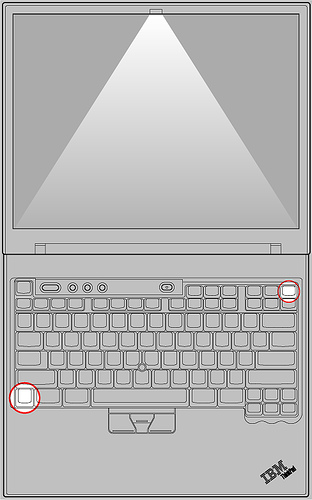
The thinklight which I blogged about recently for example. It was an invention in my head which came out of necessity (link to Friday blog). My son had book light made from a small led and batter and I saw the “light”. It came from necessity and constraint which were the inspiration. When sitting on a plane, you had to disturb the passenger next to you with the overhead light, or open and shut the monitor part of the ThinkPad to see. Ultimately, I couldn’t see the keyboard in the dark.
If someone said design a computer with no restraint for example, I would be at a loss. Constraint would be logical, a cost, a reason or a solution to a problem.
It is more challenging to design something that has to be better or fit into a smaller box.
What makes a design work or be successful?
I think that it is difficult to pin down, It can come in many ways, There are examples of great design which solves a problem, but are not a financial success. The ThinkPad 701C butterfly was such a product. It had tremendous brand building success which people talk about today. It had an element of creativeness and innovation that lives on in the ThinkPad design today.
What designs have surprised you as being more successful than you expected?
I never anticipated that the original work on the AS/400 Advanced Series would be so significant in changing the landscape to the entire line of servers, It later extended to NetFinity now System X for example. At first they weren’t rack mounted and had the same design problem as AS/400, they were uninspiring. It did work and was functional, but they were not exciting. We worked on extending the AS/400 to Netfinity in terms of design…then everything followed suit and finally the entire server line had a similar look. I never expected it to go that far. We changed the Rack mounts as the beginnings of what they are today.

It was a big battle internally to get IBM to make the servers black…in fact it was a major controversy. Very early on in his tenure as chairman, Lou Gerstner came to visit the Rochester site, only his second visit, We had a room set up with the Advanced Series on one side and Beige Racks on the other. The plan was to bring him in and give him a history of the product, Then we were going to turn his attention to the advanced black model. The server folks thought it would be way to kill it and to “get David Hill out of the way”. Well, the entourage came in and the first thing Lou said was ” wow those are the coolest computers I’ve ever seen, you must have an industrial designer”. I stepped forward and said I’m in charge of industrial design and we had a nice talk about the product, then he left. Needless to say, that was the end of the beige/black issue.
Conversely, what designs didn’t work/sell as well as you thought?
The Butterfly. I thought it was the most amazing thing I’d seen, but it was too good to be true, It combined everything about great design, utility and value with a compelling aesthetic attribute, but when larger flat-panel displays dropped in price, the volumes didn’t take off and the design was never extended.
If someone were looking to be in the design field, what advice would you give them?
Be prepared for tremendous amount of hard work which on surface may not get any attribution. Art schools are filled with emotionally charged people. There were only 8 people in my graduating class, and thousands in business school. You would find that the lights were on 24/7 in the design school. They are emotionally connected to what they are doing. You can’t cram for final on design of building. I once designed the interior of a tractor cab in college. You couldn’t cram for that. I would say that this amount of time follows you wherever you go. It’s hard to turn design off and on. Once, I bought a TV and painted the knobs because i didn’t like them.
Why did you become a blogger?
Design is a core element of Lenovo’s strategy. It spans behavior, aesthetics, emotional, ease of use and human factor. As people believe products become commoditized, design changes its value. For example, if you go to an electronics store, there are rows of toasters. Some are long, some black, some lay down, some stand up, some mount under a cabinet and many other designs. A corkscrew is another product with design differentiators. There are whole museums on this subject. Design is a way we differentiate.
It’s also about solving problems. A blog gives us chance of making people aware of design and features and solicit feedback on what they have, what they like and what they don’t like. What may be the next inspiration of new ThinkPad. Dialogue on the subject of design and the human factor to a company. Lenovo should be easy to approach and work with and a blog that supports this will help. Many blogs are corporate communications inspired and are sanitized, and not written by a designer….my blog will help bring us closer to user.
I’m also going to post about the design of motorcycles. I’ve been associated with them since I was 13…would Dell do that? It’s about me talking about design. The television show “American Chopper” is fun to watch because of the interaction between father and son. The design of choppers is mysterious.
I hope to put a human face to Lenovo, and make people think design matters.
I look at modern architecture in friends house, some homes are designed some are cookie cutter houses. It’s the same way in our industry. Some computers are designed well and some are not…read between the lines on generic computers and generic companies here.
What are you looking at (other that what is on your blog) for future Lenovo design?
We are in brand building mode. While we are strong in china, outside of china we are still growing. I want to make it iconic. We have several ideas that will do this. Perhaps at some point i may blog about it.
Share this:

More Dell Hell – Battery Recall
4 million batteries are being recalled by Dell. And it involves Sony who made the batteries.
Here’s another story about it from TechWeb.
I know we’ve all seen the exploding Dell Laptop in the Japanese boardroom. This is not a time I’d like to be in the PR department at Dell.
Since I have some close ties to Lenovo, I asked if they had the same problems. If you read the Ziff article about how they are dealing with it, you see that they are not having any of the same issues. I haven’t heard anything about HP, but since they are high profile, I’m sure it would appear quickly.
I think the issue is bigger than the battery. It is the R&D at Dell, one of the lowest in the business. They buy what is out there on a just in time basis at the lowest cost. This doesn’t give you either time to do proper quality control or allow you to use much of your own development, also vital in problem solving.
When I was in the Technology Group at IBM, we OEM’d a lot of parts to Dell. I think at one point, a Dell computer was half IBM cost wise when you included Intellectual Property. They’ve since gone to other sources as the patents for PC’s have expired and offshoring is cheaper for parts. What I learned was their MO for cheapness. The PC industry has always had price as the main reason for buying, to the point of vendors losing money and going out of business, but you get sick of quality problems and go away if the product doesn’t perform. As I go on ad nauseam, consumers vote with their money.
Since I worked in the PC division, I have seen that things like software and Design do make a difference. Lenovo is not having these Dell problems because they are better machines with seemingly the same parts.The cost of this is going to be far more than the replacement cost. It is a perception cost on quality which they don’t need right now. They should also incur a greater R&D in house cost to ensure that the proper design and testing of parts are insured.
Dell has had it’s time at the top. Most will tell you it’s harder to stay at the top than to get there. IBM has reinvented itself many times, all companies have to. We’ll see….
Share this:

The Dreaded Hard Disk Failure
Once again, a failed hard disk for me. It reports to me as a disk read error under diagnostics, but visually, it won’t boot for me.
I worked in the disk drive industry so I know the value of back up and did so of my data. I also did have a pre 2004 machine that I’m currently blogging from.
It has not spared me from the inconvenience of not having the information I need to work, and it appears that working remotely requires me to do the diagnostics to find out the specific disk error before anyone will help me. Sure they’ll assign a case number, but helpful, not yet.
Let’s hope I get this resolved or I’m going to be an unhappy camper. For now, I’m going to be a data disabled user.
Share this:

Hiroshima, August 6, 1945
Truly a turning point in the history of man with the ushering in of the nuclear age. Fortunately, it hasn’t been used again, but we’ve lived under the threat of nuclear “mutual self destruction” since then. Through the cold war to the bullying threats of North Korea and Iran, it stays in the back of our minds that the splitting of the atom is either an environmentally useful source of energy or a terrible weapon.
While many died at Hiroshima and Nagasaki (the second bomb did not strike it’s intended target so casualties were less than the first bomb), historians agree that it saved civilian lives by stopping the invasion of Japan by the Allied forces from fighting an extended battle. The Japanese have a proud history of being great warriors going back to the times of the Samurai, so giving up was not in the battle plan. Their will to perservere had to be broken or the invasion was inevitable.
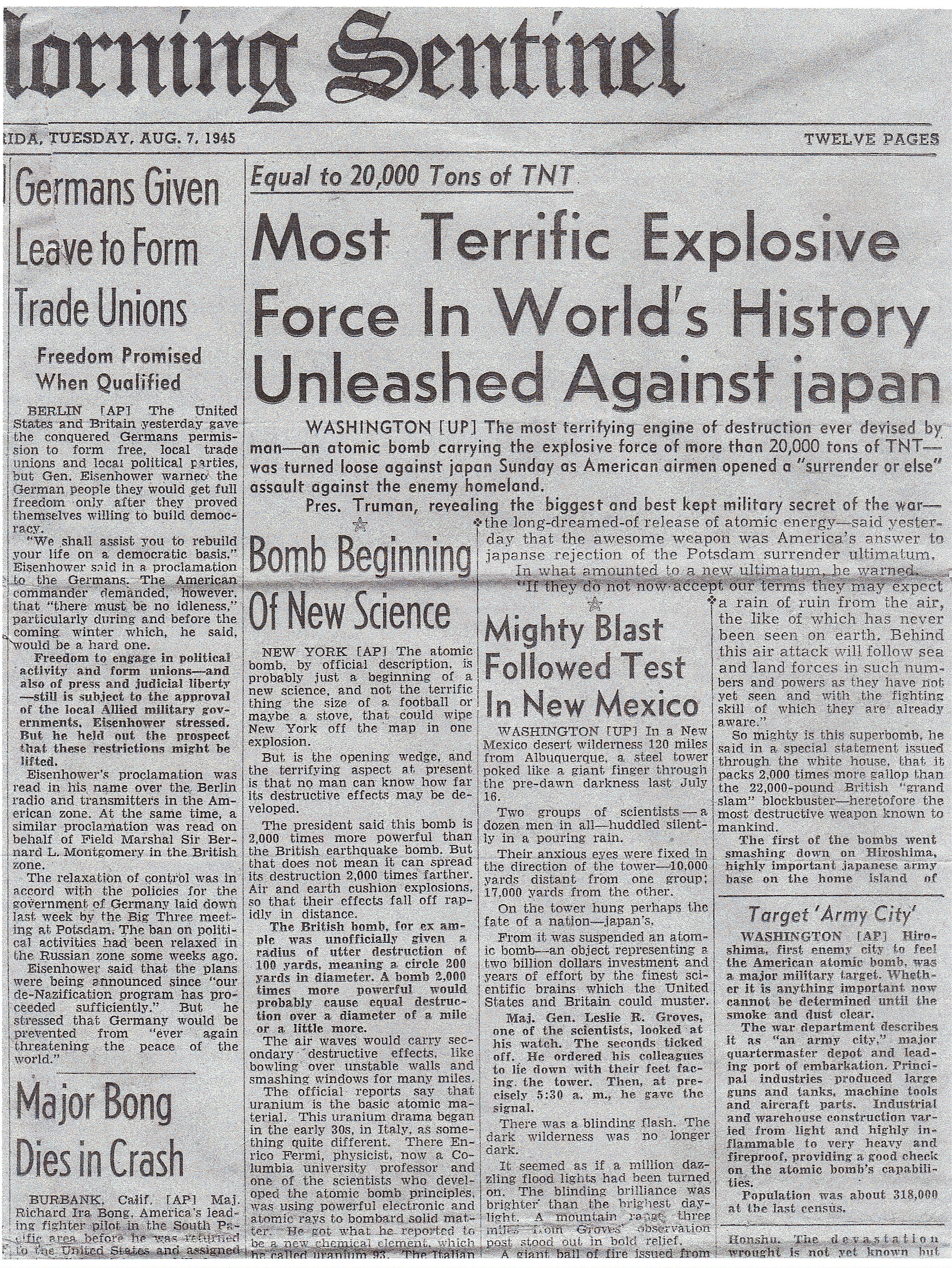
I ran across an archive of the story dated August 7, 1945 from the Orlando Sentinel when going through my father’s archives, which even then didn’t describe the magnitude due to the secrecy of this project. We had to hide the development from our enemy and use our ingenuity to create it before Hitler had the weapon, our then greatest fear.It’s a good thing the NY Times didn’t know about it and publish the story prior to attack. Interesting that it describes the target as an Army city.
It is known that the fuse for the bomb fuse was radio proximity technology, which my father helped develop during the war.
Share this:

You know you are living in 2006 when…
1. You accidentally enter your password on the microwave.
2. You haven’t played solitaire with real cards in years.
3. You have a list of 15 phone numbers to reach your family of 3.
4. You e-mail the person who works at the
desk next to you.
5. Your reason for not staying in touch with friends and family is that they don’t have e-mail addresses.
6. You pull up in your own driveway and use your cell phone to see if anyone is home to help you carry in the groceries.
7. Every commercial on television has a web site at the bottom of the screen.
8. Leaving the house without your cell phone, which you didn’t have the first 20 or 30 (or 60) years of your life, is now a cause for panic and you turn around to go and get it.
10. You get up in the morning and go on line before getting your
coffee.
11. You start tilting your head sideways to smile.
: )
12. You’re reading this and nodding and laughing.
13. Even worse, you know exactly to whom you are going to forward this message.
14. You are too busy to notice there was no #9 on this list.
15. You actually scrolled back up to check that there wasn’t a #9 on this list
AND NOW U R LAUGHING at yourself.
Share this:

USS Indianapolis
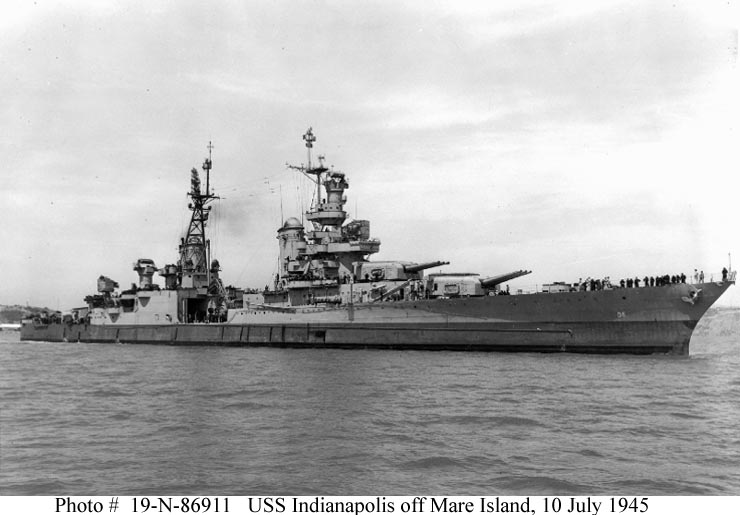
On July 30, 1945, the USS Indianapolis was sunk after delivering the Hiroshima bomb on a super secret mission. So secret, it was days before it was even noticed missing.
When it was hit, 900 of the 1196 men went into the water. Less than 300 came out when they were sighted by accident and rescued after those horrible days. If you recall the movie Jaws, Quint told the story of what happened to the men. Although some died from the torpedo blast, most drowned or were taken by sharks. I always thought as a kid that being eaten was the worst way to go, but I was thinking Lion at the time.
I watched a show on the History Channel about this fateful voyage. Most of the men didn’t even know that they were delivering the “bumb” as Quint called it.

Here’s the description from the movie that tells the gruesome details:
Hooper: You were on the Indianapolis?
Brody: What happened?
Quint: Japanese submarine slammed two torpedoes into our side, Chief. We was comin’ back from the island of Tinian to Leyte… just delivered the bomb. The Hiroshima bomb. Eleven hundred men went into the water. Vessel went down in 12 minutes. Didn’t see the first shark for about a half an hour. Tiger. 13-footer. You know how you know that when you’re in the water, Chief? You tell by looking from the dorsal to the tail. What we didn’t know, was our bomb mission had been so secret, no distress signal had been sent. They didn’t even list us overdue for a week. Very first light, Chief, sharks come cruisin’, so we formed ourselves into tight groups. You know, it was kinda like old squares in the battle like you see in the calendar named “The Battle of Waterloo” and the idea was: shark comes to the nearest man, that man he starts poundin’ and hollerin’ and screamin’ and sometimes the shark go away… but sometimes he wouldn’t go away. Sometimes that shark he looks right into ya. Right into your eyes. And, you know, the thing about a shark… he’s got lifeless eyes. Black eyes. Like a doll’s eyes. When he comes at ya, doesn’t seem to be living… until he bites ya, and those black eyes roll over white and then… ah then you hear that terrible high-pitched screamin’. The ocean turns red, and despite all the poundin’ and the hollerin’, they all come in and they… rip you to pieces. You know by the end of that first dawn, lost a hundred men. I don’t know how many sharks, maybe a thousand. I know how many men, they averaged six an hour. On Thursday morning, Chief, I bumped into a friend of mine, Herbie Robinson from Cleveland. Baseball player. Boatswain’s mate. I thought he was asleep. I reached over to wake him up. Bobbed up, down in the water just like a kinda top. Upended. Well, he’d been bitten in half below the waist. Noon, the fifth day, Mr. Hooper, a Lockheed Ventura saw us. He swung in low and he saw us… he was a young pilot, a lot younger than Mr. Hooper. Anyway, he saw us and he come in low and three hours later a big fat PBY comes down and starts to pick us up. You know that was the time I was most frightened… waitin’ for my turn. I’ll never put on a lifejacket again. So, eleven hundred men went in the water; 316 men come out and the sharks took the rest, July the 30th, 1945. Anyway, we delivered the bomb.
In 2017, a search from Paul Allen of Microsoft has found the wreckage of the Indianapolis 3 miles under the surface on the ocean floor. It is for some an undersea tomb as is the USS Arizona.
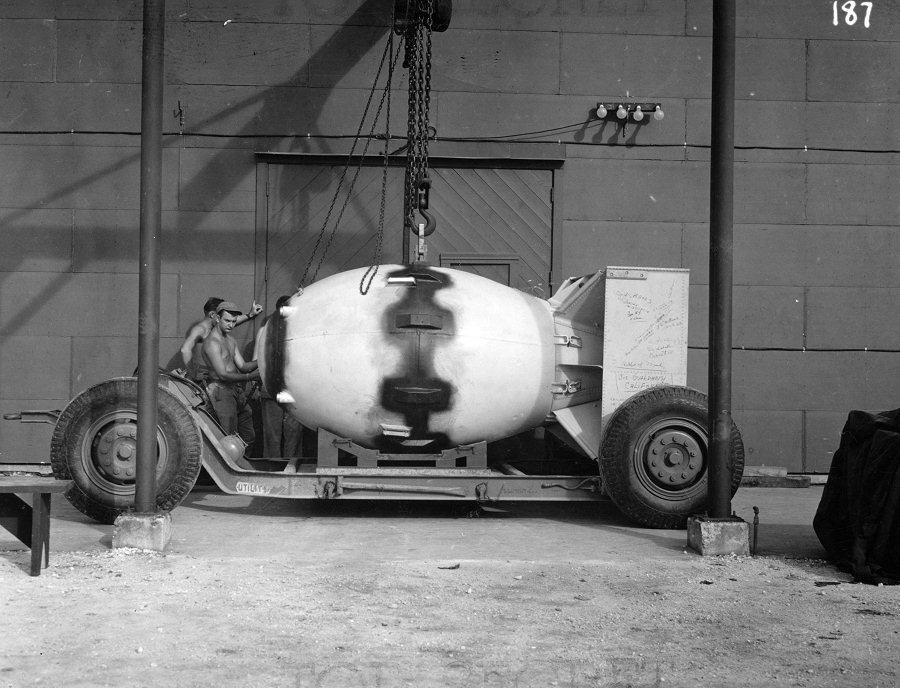
Here is a picture of the Fat Boy bomb that was on the Indianapolis. I recently visited ground zero and the Hiroshima museum. It made it clear from the pictures of women, kids and old people who were being trained to fight as both sides anticipated an invasion.
Ground Zero where it was dropped:
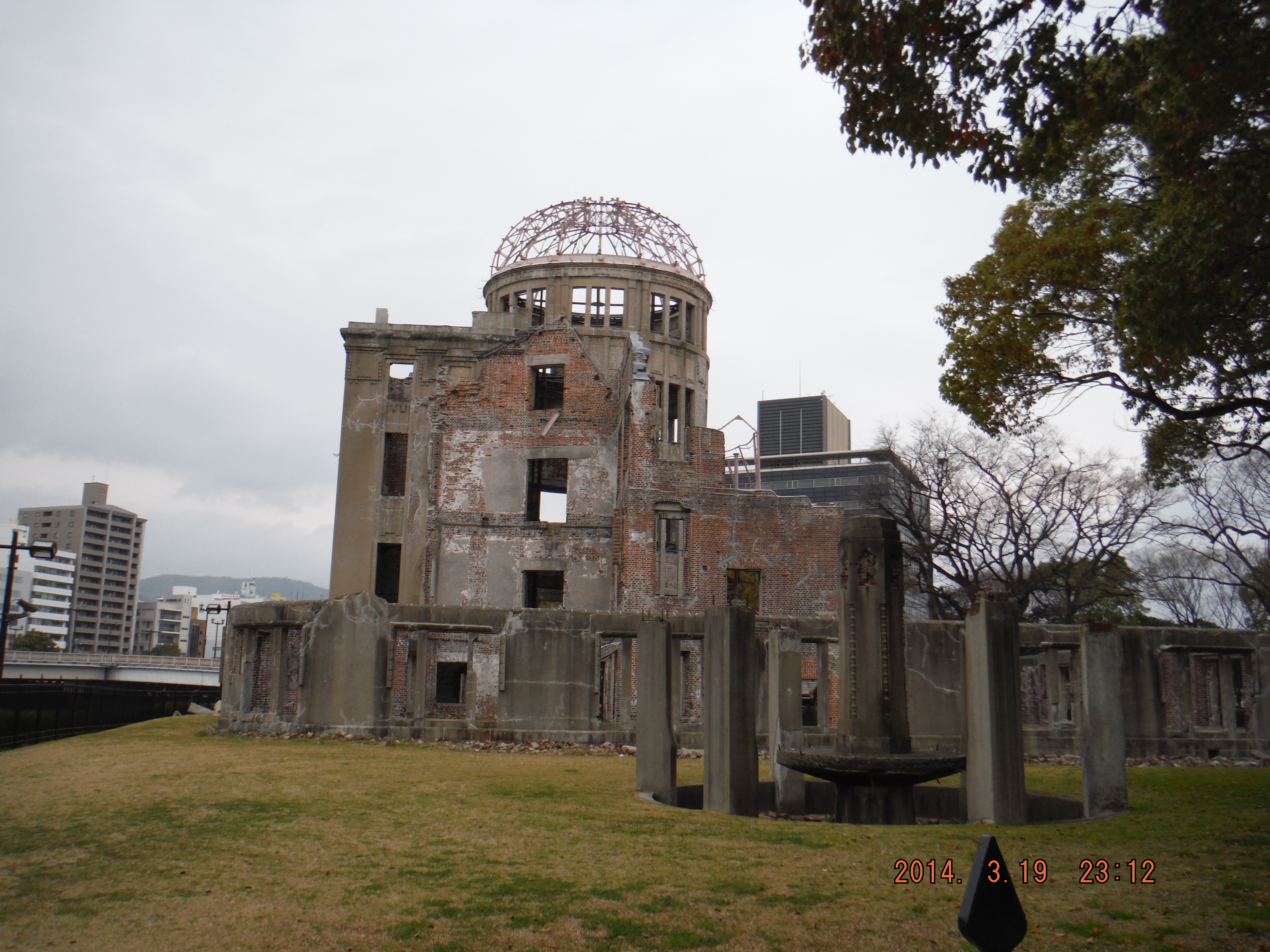 Shortly after this, the bomb was dropped and the war in the pacific theater was over. God bless those men who made the ultimate sacrifice for peace and freedom. They saved millions of lives as the Japanese were preparing to kill or die in an invasion. Upwards of 2 million lives were saved.
Nagasaki was chosen as the next target as it was mainly occupied by military forces, so it was both strategic and civilian collateral damage was held back.
Further, evidence was found that the Japanese had their own nuclear bomb and tested it on the Island of Hungnam days after the “bomb” was dropped on Hiroshima. So this act not only saved millions of lives, it now appears to have stopped a nuclear war. Reporter David Snell has documented this.
DID IT SAVE LIVES?
If you look at the last battle before dropping the bomb which was Okinawa, it was one of the most bloody battles of the Pacific. Japan would have been worse for both the US and the Japanese.
Victor Davis Hanson describes it below.
There were also some 2 million Japanese soldiers fighting throughout the Pacific, China and Burma — and hundreds of thousands of Allied prisoners and Asian civilians being held in Japanese prisoner of war and slave labor camps. Thousands of civilians were dying every day at the hands of Japanese barbarism. The bombs stopped that carnage as well.
The Soviet Union, which signed a non-aggression pact with Japan in 1941, had opportunistically attacked Japan on the very day of the Nagasaki bombing.
By cutting short the Soviet invasion, the bombings saved not only millions more lives, but kept the Soviets out of postwar Japan, which otherwise might have experienced a catastrophe similar to the subsequent Korean War.
World War II was the most deadly event in human history. Some 60 million people perished in the six years between Germany’s surprise invasion of Poland on Sept. 1, 1939, and the official Japanese surrender on Sept. 2, 1945. No natural disaster — neither the flu pandemic of 1918 nor even the 14th-century bubonic plague that killed nearly two-thirds of Europe’s population — came close to the death toll of World War II.
Perhaps 80 percent of the dead were civilians, mostly Russians and Chinese who died at the hands of Nazi Germany and Imperial Japan. Both aggressors deliberately executed and starved to death millions of innocents.
World War II was also one of the few wars in history in which the losers, Japan and Germany, lost far fewer lives than did the winners. There were roughly five times as many deaths on the Allied side, both military and civilian, as on the Axis side.
It is fine for Secretary of State Kerry and President Obama to honor the Hiroshima and Nagasaki victims. But in a historical and moral sense, any such commemoration must be offered in the context of Japanese and German aggression. What the president forgot were these actions that were stopped at Hiroshima:
He forgot the Bataan Death March conducted by the peaceful Japanese war machine.
He forgot the Sandakan Death March
He forgot murder and cannibalism on the Kokoda Track.
He forgot conscripting women for sexual slavery in Japanese Army brothels.
He forgot the mutilation and murder of Dutch civilians in Borneo.
He forgot the murder and cannibalism of captured American pilots.
He forgot the murder of American pilots and air crew at Midway.
He forgot the bombing of the hospital ship Manunda.
He forgot the sinking of the hospital ship Centaur.
Nazi Germany and Imperial Japan started the respective European and Pacific theaters of World War II with surprise attacks on neutral nations. Their uniquely barbaric war-making led to the deaths of some 50 million Allied soldiers, civilians and neutrals — a toll more than 500 times as high as that of Hiroshima.
Update: The last surviving member of the Enola Gay died at age 93 in July of 2016. Theodore Van Kirk was the navigator. a brief excerpt regarding the issue of War and dropping the bomb is as follows:
The crews that dropped the atomic bombs on Hiroshima and Nagasaki were seen by Americans as saviors for ending the war. But over the years, the morality of atomic warfare and the need for the bombings has been questioned.
Mr. Van Kirk joined his fellow crewmen in unwavering defense of the atomic raids.
“We were fighting an enemy that had a reputation for never surrendering, never accepting defeat,” he said. “It’s really hard to talk about morality and war in the same sentence.”
He continued: “Where was the morality in the bombing of Coventry, or the bombing of Dresden, or the Bataan Death March, or the Rape of Nanking, or the bombing of Pearl Harbor? I believe that when you’re in a war, a nation must have the courage to do what it must to win the war with a minimum loss of lives.”
UPDATE 2: I ran across this article recently discussing “A Reality Check For Those Who Deplore The Nuking Of Japan”. It’s a good read and another intellectually intriguing article on the morality of bombing vs. fighting.
Excerpt:
Nowadays, many question whether those bombs were necessary. Given that they killed almost exclusively civilians and that the second of the two was dropped only two days after the first, many people have concluded that the attack was immoral. Today, the typical American is likely to react to the words “Hiroshima” and “Nagasaki” with a vague sense that our country did something wrong.
But the nuking of Japan was a moral act: war is hell for those who do the actual fighting, so those two bombs put an end to their suffering. This was true for the soldiers on both sides (even a Japanese soldier must have felt relieved to know he was going to survive unscathed). A purely theoretical model for explaining why dropping nukes was bad appeals only to those who have no skin in the game.
The Japanese war had already killed millions, most of whom were civilians. The two nukes killed 140,000. Do the math. It is a distasteful application of arithmetic, but it is an application that soldiers have to do all the time in their struggle to win a war.

 Delusions of Adequacy